


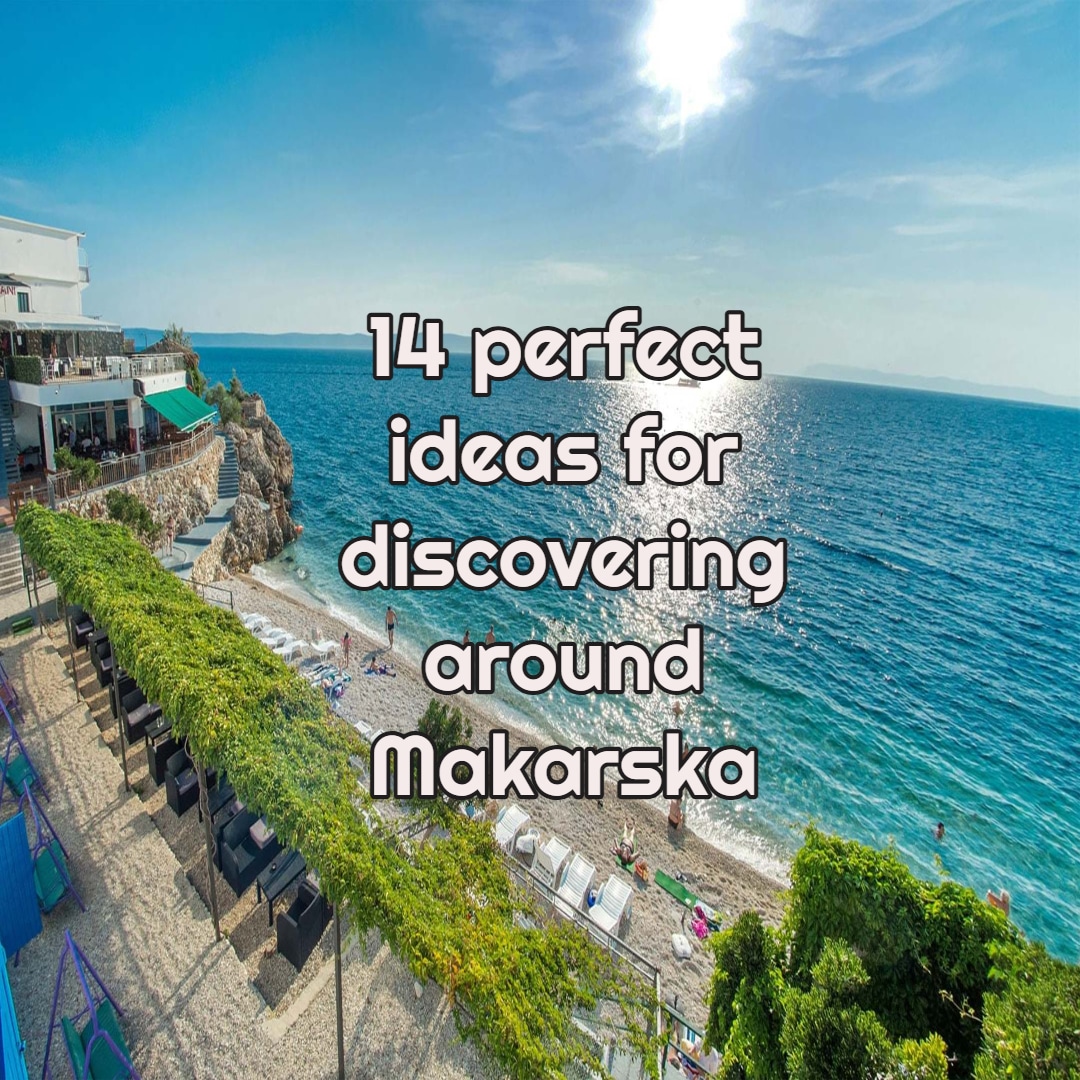
Makarska: 14 perfect ideas for discovering around Makarska
Makarska. Between the silver peaks of Mount Biokovo and the deep blue of the Adriatic, it sits like a jewel in the heart of the Dalmatian coast. Its promenade hums with summer life – boats, cafes, laughter – but behind every beach lies a story, and behind every horizon a new adventure.
This is a place where mountains meet the sea, where islands float within reach, and where centuries of history whisper through the stone and salty air. Here’s what you can see while staying at Beach Hotel Plaža, Drašnice.
Discover Makarska itself
Before you set sail or head into the hills, take a day or two to explore Makarska’s treasures.
The Sveti Petar Peninsula
Walk to the top of the Sveti Petar Peninsula, a pine-clad pass that protectively envelops Makarska Harbor. The path winds through the shade of pines and tamarisks until it reaches the Statue of St. Peter, who eternally gazes out to sea. From here, views stretch across the bay to the island of Brač – the perfect spot for sunrise or a romantic sunset stroll.
Veprić Sanctuary
Tucked away in a peaceful valley below the cliffs of Biokovo is the Veprić Sanctuary, often called the Croatian Lourdes. Built around a natural cave and stream, it is a peaceful place of pilgrimage and reflection, surrounded by greenery and birdsong. Whether you come for faith or simply for peace, Veprić seems timeless – a place to rest and respite.
Malacological Museum
Tucked away in an old Franciscan monastery, the Malacological Museum of Makarska is a small wonder in itself. It houses one of Europe’s finest collections of shells and marine fossils, collected from all over the world. The exhibition – thousands of shapes and colours shimmering under glass – pays homage to the sea that defines Makarska’s identity.
Tučepi – The Soft Heart of the Riviera
South of the city lies Tučepi, where the beach seems endless and pine trees gently bend towards the waves. This is the Riviera at its most peaceful – long promenades, quiet cafes and the smell of salt and resin in the air.
From Tučepi you can easily reach the hiking trails that climb to the foot of Biokovo, offering breathtaking views of the coast below.
Podgora – The Village of Sailors
Further along the coast, Podgora combines old-world charm with maritime tranquility. Its coastline is dotted with colorful boats, and above the village stands the monument to the Wings of the Seagull, a memorial to local sailors who fought in World War II.
Podgora’s beaches are peaceful, the sea perfectly clear, and the seafood as fresh as the morning’s catch.
Mount Biokovo — The Sky Above the Sea
Behind Makarska rises Mount Biokovo, one of the most beautiful mountains in Croatia. In a matter of minutes, you can ride from sea level to over 1,700 meters into the clouds.
The Biokovo Skywalk, a glass platform jutting out over the cliffs, offers dizzying views of the coastline — the islands shimmer like jewels below. Continue to Sveti Jure, the highest peak in the region, where the Adriatic stretches endlessly to the horizon.
Biokovo is a mountain of contrasts: rugged and rugged, yet alive with wildlife, butterflies, and silence.
Bast Stone Village — Life Below the Mountain
On the lower slopes of Biokovo, Bast clings to the hillside, a cluster of stone houses surrounded by olive groves and fig trees. From its terraces, the view of the Makarska Riviera is breathtaking.
Time seems to slow down here. Local taverns serve roast lamb and cheese. It’s a place where you can taste simplicity and watch the light change over the sea.
Brač — The Island of White Stone and Wind
A short ferry ride from Makarska brings you to Sumartin on the island of Brač — a rugged, sun-drenched world of stone villages, olive groves and hidden coves.
Brač is home to Croatia’s most famous beach, Zlatni rat in Bol, a golden tongue of sand that changes shape with the wind. Climb Vidova Gora, the highest point of any Adriatic island, for views that stretch from Hvar to Vis.
Hvar — Light, Lavender, and Long Evenings
Hvar is a place where elegance meets nature — sun-drenched towns, lavender-scented hills, and the rhythm of island life. Hvar Town is full of marble streets, Venetian architecture, and lively harbor cafes.
Head to Stari Grad, one of Europe’s oldest towns, to see ancient stone walls and quiet courtyards. Or escape to Pakleni Islands, a short boat ride away, where pine forests hide small, picture-perfect beaches.
Korčula — Island of Legends
Sail further south and you’ll reach Korčula, a medieval walled town often called Little Dubrovnik. Its narrow streets spiral out to the sea, shaded by red roofs and bougainvillea.
Legend has it that Marco Polo was born here — whether
True or not, the spirit of exploration lives on in every stone. Sample local food and stay for an evening performance of Moreška, an ancient tale told through rhythm and steel.
Vis — Wild and Hidden
Remote and untamed, Vis was once a military outpost and only opened to visitors in the 1990s — a fact that has preserved its pristine beauty.
Visit Stiniva Bay, a narrow inlet that opens into a secluded pebbled bay, or take a boat to the legendary Blue Cave on nearby Biševo Island, where sunlight turns the water into a shimmering sapphire.
Komiža, a small fishing village, feels like time has stood still — the evenings here are slow, salty, and beautiful.
Imotski — Lakes Under the Earth
Inland from Makarska, the landscape changes from coast to karst. The town of Imotski is home to two natural wonders: Modro jezero, which fills and empties depending on the seasons, and Crveno jezero, a vast sinkhole that cuts deep into the rock.
Nearby is Prološko blato, a wide karst field that transforms into a shimmering swamp every spring. A small stone church sits on an island amidst reeds – an almost dreamlike sight that captures the spirit of inland Dalmatia.
Mljet — Green Island
Further south, Mljet is the emerald heart of the Adriatic — an island of forests, lakes and silence. Much of the island is protected as the Mljet National Park, where two saltwater lakes (Veliko and Malo jezero) shimmer beneath pine trees.
In the middle of the larger lake is a small island with a Benedictine monastery, reachable by small boat — a vision of peace surrounded by water and trees. Mljet seems otherworldly: lush, quiet, and deeply calming.
Krka National Park — Dalmatian Waterfalls
A few hours north, near Šibenik, lies Krka National Park, one of Croatia’s most magical natural wonders. The Krka River flows through forests and limestone gorges, creating pools and waterfalls that shimmer in green and turquoise.
Walk the wooden paths around Skradinski buk, the park’s largest waterfall, or take a boat to Visovac Island, home to a quiet Franciscan monastery floating on the river. It’s a place where time seems fluid and the sound of the water never stops.
Zaostrog — Peace on the Southern Edge
At the southern end of the Makarska Riviera, Zaostrog is a peaceful coastal town surrounded by mountains and sea. The Franciscan Monastery of St. Mary, dating back to the 15th century, houses a rich library and museum.
Zaostrog’s beaches are peaceful, the water crystal clear, and the atmosphere quietly spiritual — the perfect place to end your coastal journey.
Dubrovnik
Continue your journey south and you’ll reach Dubrovnik, the crown jewel of the Croatian coast. Surrounded by massive stone walls, its Old Town is a maze of marble streets, Gothic towers, and Baroque churches that rise above the Adriatic.
Stroll along the city walls at sunset, as the sea shimmers golden below. Visit the Lovrijenac Fortress, known as the “Gibraltar of Dubrovnik”, and gaze over the red roofs that have inspired travelers for centuries.
Evening brings music, candlelight and the sound of conversation that wafts from centuries-old taverns. Dubrovnik is not just a city — it is a living monument, where every stone tells a story.
The Soul of the Makarska Riviera
From the silent pines of the Sveti Petar peninsula to the clouds above Biokovo, from the ancient towns of Hvar to Lake Imotski, everything around Makarska feels connected – sea with stone, light with wind, faith with nature.
Here you can swim in the morning, climb the mountains until noon and toast the sunset on an island terrace in the evening. Makarska is more than a destination – it is the heart of Dalmatia, beating between land and sea.


About Post Author
